
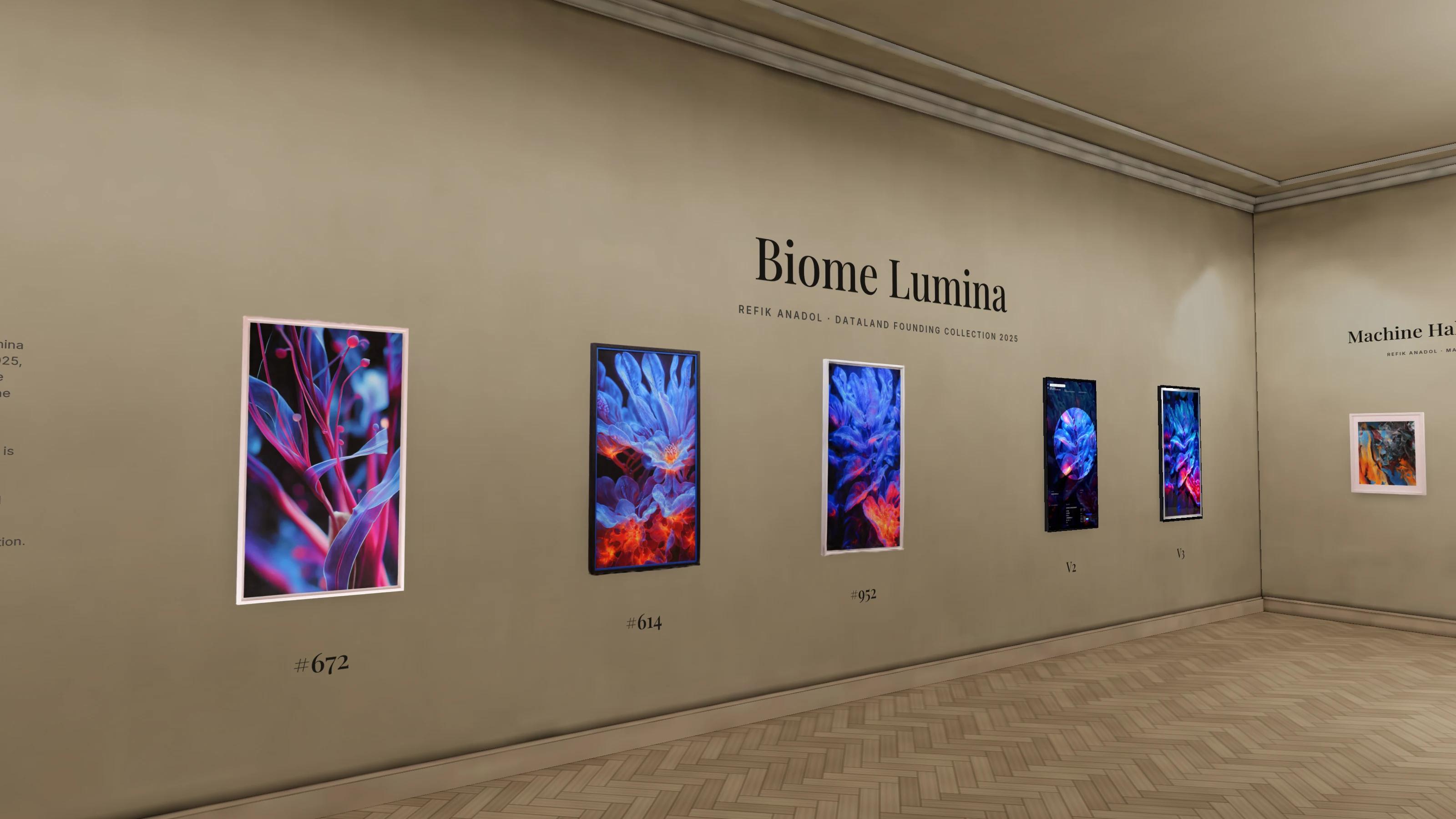

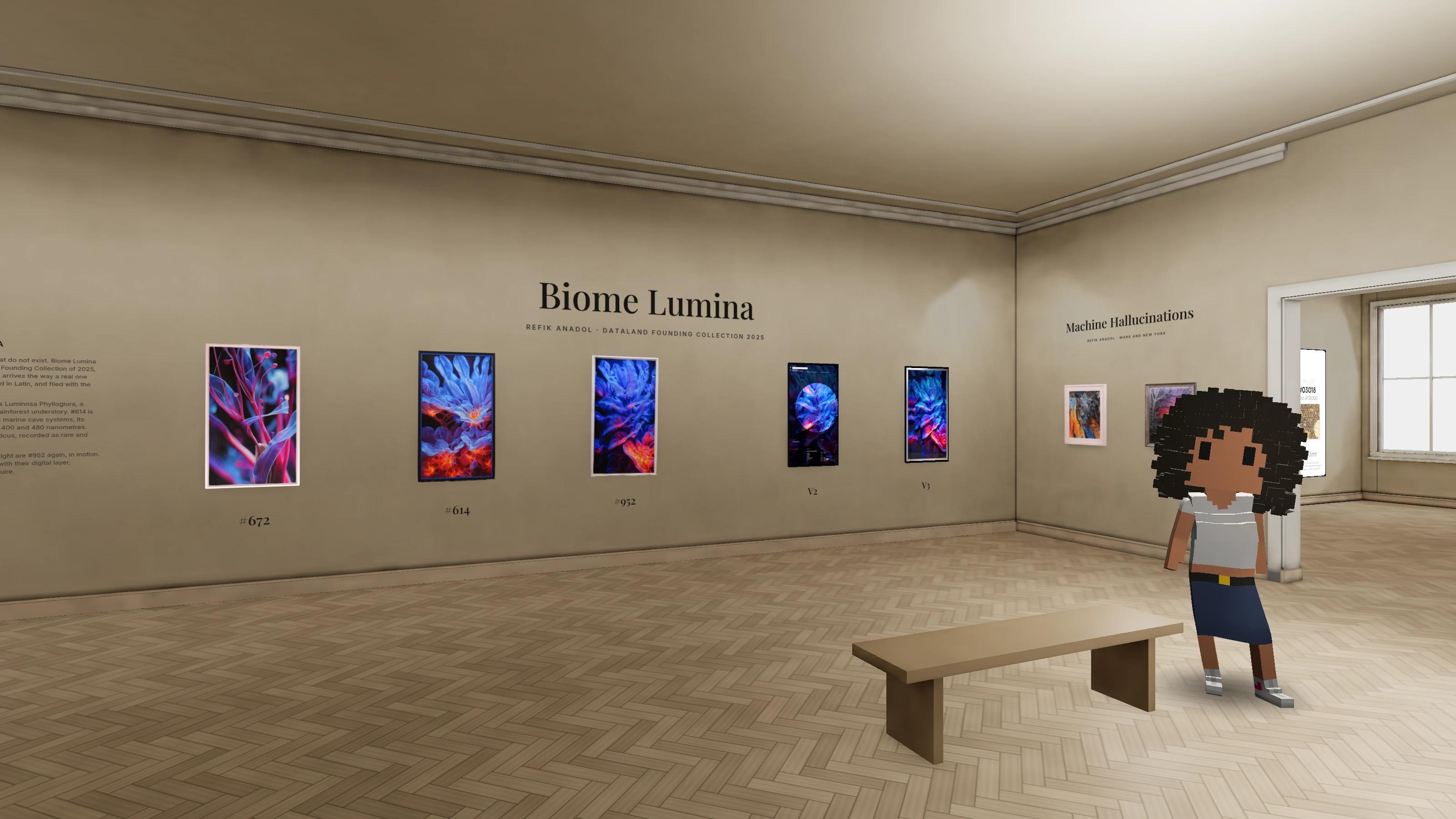
Galerie Midl has a door that never closes. On a computer, the 3D gallery opens onto four rooms in which every work in the collection hangs at its real size, as a scan of the physical object rather than a photograph of it. Midl waits by the bench in the main room, at three in the afternoon and at three in the morning.
This is a short tour: what the gallery is, how Midl works inside it, and the technology that holds it together.
A gallery you can walk into
The visit begins in an entry corridor, with Olaolu Slawn’s 3 Arthurs beside you and the four colours of Trevor Andrew’s Gucci Ghost in a row. Fifteen metres ahead, framed by the doorway, the main wall carries three prints from Refik Anadol’s Biome Lumina. In that room Winds of Yawanawa hangs opposite, Machine Hallucinations takes the east wall, and Nychos’s Howl at the Moon the west.
A side room holds a conversation across a century: Gustav Klimt’s The Kiss, Trevor Jones’s The Bitcoin Angel, William Mapan’s Superpositions #250, and Slimesunday’s print GILD3D beside three works from ACIDW@SH. The visit closes in a cooler, darker corridor with Data Universe (Inspiration4).
Every work hangs on one line, its centre at 1.52 metres, just below the eye height of an average visitor. Museum texts on the walls introduce each artist, and screens beside the prints show the digital counterpart of the same work in motion. There are no price labels on the walls; the price and the lease terms are one click away. On a phone the gallery page shows the works and leads to the collection, because the walkthrough is built for a keyboard and a mouse.
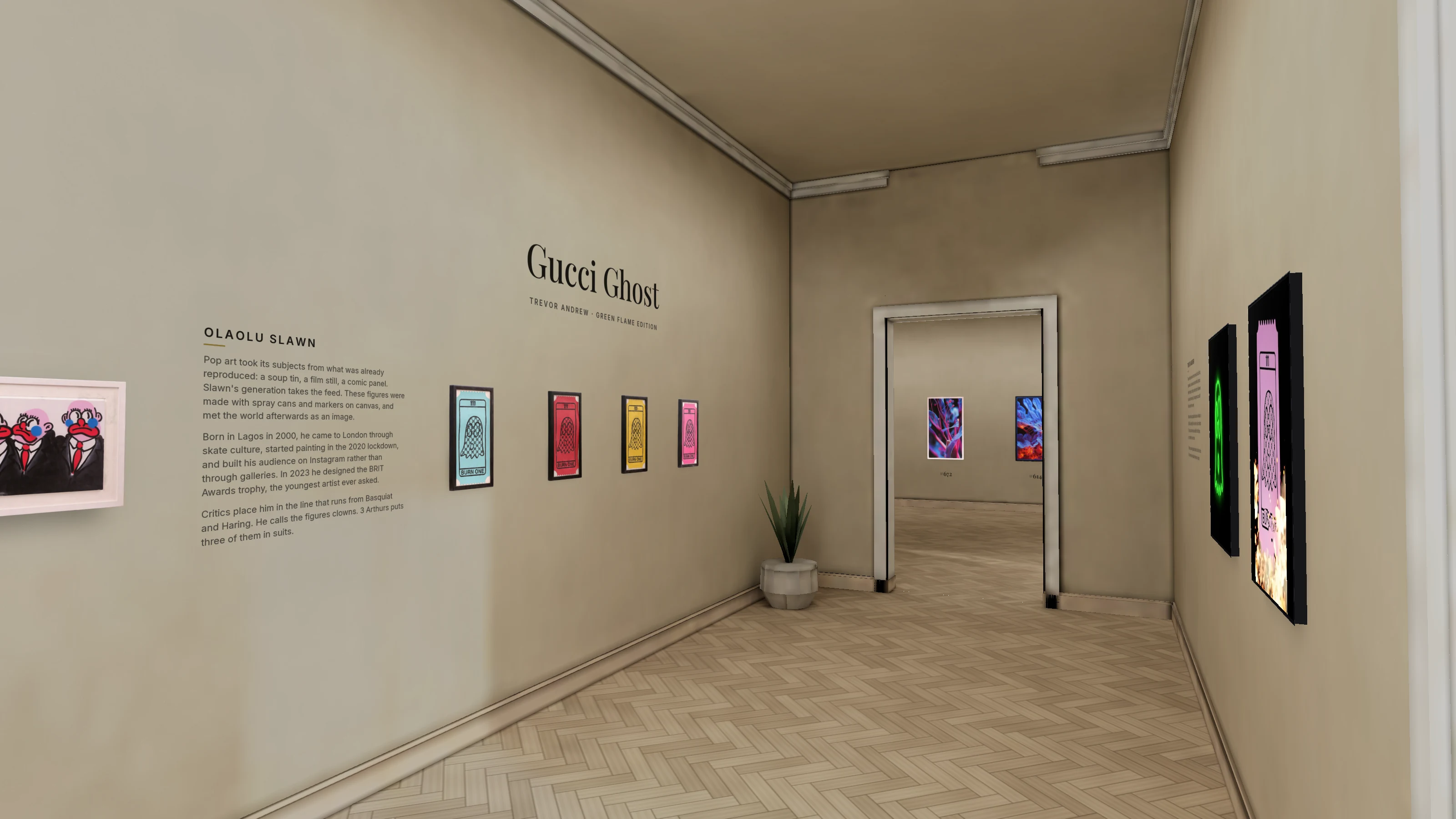
Every work is a scan, not a picture
The works in the gallery are Gaussian splats. The Vienna studio geofront photographs each framed print from hundreds of positions and reconstructs it as millions of small, soft, coloured ellipses in space. The method was introduced in a 2023 paper by Bernhard Kerbl, Georgios Kopanas, Thomas Leimkühler, and George Drettakis, and it has since moved from research labs into browsers, phones, and headsets.
A splat is not a model with a picture painted on it. It records how a surface holds light, how deep a frame sits, and how paper and glazing change as you move. Walk up to Biome Lumina #952 and a sharper version of the scan loads without interrupting the walk; step to the side and the frame’s depth turns with you. The print on the wall and the scan in the gallery are two views of one work.
Midl, the gallerist who does not close
Midl is the gallery’s gallerist, and in the 3D gallery she has a body: a figure 1.70 metres tall who waits by the bench in the main room. Walk up to her and she greets you. Open the conversation and she knows which work you are standing in front of, so a question as short as “what is this?” gets an answer about that piece, its artist, and the kind of room it suits.
Once you have written to her, she walks with you from room to room, keeping a polite distance. She answers in English or German at any hour, and a lease enquiry can go from the first question to everything our team needs for an offer without anyone waiting for office hours. The same Midl lives on every product page, where the 3D GALLERY button shows the work in its place on the gallery wall, with Midl beside it and the conversation open next to the room.
How it is built
The gallery is a single web page with nothing to install. A handful of decisions hold it together.
- One floor plan: every wall, door, and window is defined once, and the walls you see, the walls you cannot walk through, and the light all come from that plan.
- Baked daylight: the rooms are lit in Blender by one low morning sun through the windows, and the result is stored in the walls, so the browser shows finished light instead of calculating it.
- Splats in the browser: the scans are drawn by Spark, an open Gaussian splat renderer for three.js, inside a React Three Fiber scene.
- Detail where you look: each work has a light version for the room and a detailed one for close viewing, and each room loads as you approach it.
- A body for Midl: she is a VRM avatar based on her Meebit, and her stride is computed from the distance she walks, so her feet never slide.
The rooms borrow from Viennese Gründerzeit interiors: warm plaster, herringbone parquet, cornices, and tall windows. They are the kind of rooms many Vienna offices and practices already occupy, which is the point.
What it changes before a lease
A lease starts with a room, and a room is judged at scale. In the gallery a practice manager or a founder can see how a Classic work compares with a Premium one, how a set of four reads as a row, and how a print sits beside its own digital counterpart, before anything is delivered.
It also keeps the collection open on a Sunday evening, when many decisions about a room are actually made. Midl can answer the first questions then, and the gallery replies in person within one working day.
Walk through the 3D gallery on a computer, and when a work stops you, ask Midl about it.
Sources
- 3D Gaussian Splatting for Real-Time Radiance Field Rendering, project page. Inria, GraphDeco research group.
- 3D Gaussian Splatting for Real-Time Radiance Field Rendering, the authors’ video. GraphDeco, Inria. (video)
- Gaussian Splatting Guide. geofront e.U.
- Spark, a Gaussian splat renderer for three.js. World Labs.
- Streaming 3DGS worlds on the web. World Labs.
- Render Baking. Blender Manual.
- Intel Open Image Denoise. Intel.
- VRM, a file format for 3D humanoid avatars. VRM Consortium.
- Explore advances in RealityKit, WWDC26 session. Apple Developer. (video)
- Gründerzeit. Wien Geschichte Wiki.